Friday, May 11, 2012

Weekend in Dublin -- Fry-up and Gold

After a too early wake-up, we caught the 8:20 am flight to Dublin and were headed for our hotel by 10:30 -- gotta love how close everything here is!  My dad's cousin Mary Webb met us at the airport, and her husband John greeted us with a delicious fry-up (eggs, sausages, rashers, black pudding, and brown bread).  Fortified we headed down to the city center to meet Liam's family friend Mary and tour the National Museum of Archaeology.

This museum displays a lot of ancient gold artifacts, as well as impressive artifacts from early life in Ireland, including Viking times.  Here are the photos I took before I noticed the No Photography signs.


Then we wandered down to St Stephen's Green, which is a beautiful park with lots of sculptures -- Rebellion martyrs, poets, Irish nationalists, etc.

Cormac and Declan circle Nationalist, Wolfe Tone

with family friend Mary

my dad and Holly


If you were in my junior English class, you would have read the Yeats' poem Easter 1916.  This poem's repetition of the line "A terrible beauty is born" shows the conflict between the desire for change and the often resulting violence.  Yeats also describes some of the martyrs and how the speaker knew them and thought little of them until they put their lives on the line for their beliefs.  For example, Yeats described the woman below as
That woman's days were spent
In ignorant good-will,
Her nights in argument
Until her voice grew shrill.
What voice more sweet than hers
When, young and beautiful,
She rode to harriers?


After wandering through a very crowded downtown shopping area, we made our way across the Liffey River to O'Connell St and saw the bullet holes from the Easter 1916 uprising outside the General Post Office.

Dinner at Beshoff Chippery based on the recommendation of our friends Kate, John, Connor and Clair who spent a year in Dublin on their own Fullbright trip.  The food was good but not spectacular, but our standards are pretty high after eating many fish and chip meals in Glasgow. And, the location could not be beat!

Connor and Claire, this photo is for you!

Now, Liam and I are off to the hotel's pub for a pint.  And we'll pack in another full day tomorrow (though hopefully with a later start).

Wednesday, May 9, 2012

Farriers and Stained Glass

For my dad and Holly's first full day, we took them to the Pollok Park to see the gardens and the Burrell Collection.  Pollok Country Park includes the original estate house, outbuildings and gardens; Clydesdale horses and Highland cattle; an art museum and cafe; playground; prehistoric circle; and lovely woods.  Definitely worth a visit if you're ever in Glasgow.

I love seeing the gardens in our regular haunts of Glasgow as they change over time.  I was in the Pollok House gardens less than a month ago with my mom, and since then the perennials have leaped into action and the spring bulbs have been supplanted by primroses.  One of my favorite parts of these extensive gardens is the Japanese section with its waterfalls and rocks.


Grampy befriends a kitty

My paternal grandfather was the groom for Amelia Peabody, so my father grew up in a house that was adjacent to the stables of Miss Peabody's home in Dover, Mass.  This horse connection made a trip to the estate's stables nostalgic for my dad, especially when we saw the farriers replacing the horses' shoes and talked with some of the workers about what horses get fed now compared to back when my dad was growing up (no eggs, no hot bran mash, more fiber).

hammering the shoe into the right shape

checking the fit -- that steam is from the hot shoe pressed against the horse's hoof

adjusting the fit

A quick trip by the Highland cattle who live in the park.


We had a delicious lunch in the cafe at the Burrell -- best options: baked potato with chickpea and mushroom tikka topping or tuna melt panini.  Then, took a tour of Burrell's collection of stained glass with a guide who had loads of information to share.  Very interesting, but I think the guides in general could tell a bit less so that the listener can absorb more (have to remember that when I go back to teaching).  Below are the three most common depictions we saw -- heraldry, saints and biblical scenes.

combined family crests

Saint Barbara, patron saint of gun makers

figures kneeling along the bottom are the donors and their seven children

Tuesday, May 8, 2012

Bellahouston Park

On Sunday, we went to check out a new park -- Bellahouston Park promised many splendors: sunken garden, sculpture play area, Mackintosh-designed house, Alice in Wonderland-inspired maze, dry-slope skiing, etc.  As is the norm in life, some things lived up to our expectations and some things fell short.

The sunken garden in my mind was going to be a secret tangle of amazing plants, instead was concrete blocks in the former basement of the house that was part of the estate (owned by the Rowan family from 1726-1871) which became the park when the family donated it to the city.  The maze also was going to be a complicated, mirrored puzzle, but turned out to be quite simple, though it did have some interesting use of metal panels interspersed with the hedges.


The Mackintosh house was closed for a private event, so we couldn't see the exhibits there.


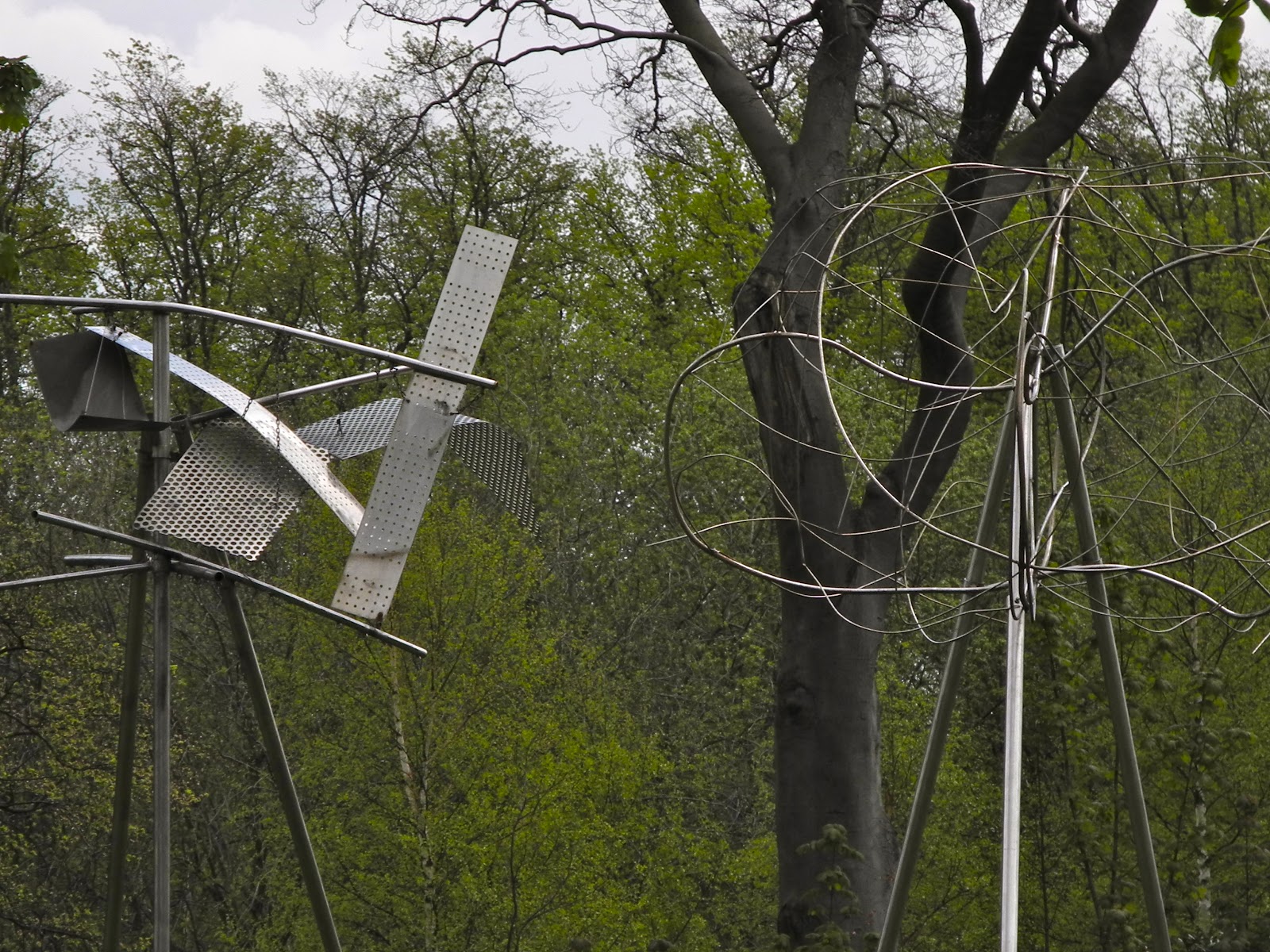
Still, the park was a great place to visit due to its sweeping vistas and multiple sculptures and fabulous pool.  In the middle of the park is a hill from which you can see the expanse of the park itself and the hills beyond -- a truly spectacular view.  At one end of the park is a play area designed by artists, so along with the usual playground equipment there are wooden chairs sunken in the ground, a rainbow bridge, and these giant, metal sculptures.


Sculptures near the Mackintosh house

"Homage to Shipbuilding" -- opposite side is a shipyard worker (owner of the dog)

"Foot and Arch" by Ganesh Gohain


A walled garden with a star-shaped bed -- never have seen that shape before.


Skiing without snow! We didn't try since it seemed a little silly to us, especially the people dressed in snowpants and parkas on a 50 degree day.


But the best aspect of this park, which will make us return again was the swimming pool at the leisure center.   Many choices -- lap lanes, showering fountain, whirlpool, slide.  You could even swim through a door to an outside part of the pool.


On the way back to the subway, we stopped into a chippery where Cormac ordered a hamburger -- it was dipped in batter and deep-fried (not what we expected)!


My dad and Holly arrived yesterday, and after a low-key day of the Botanics and dinner at the flat, today we'll take them on a full day of tourist fun!

Sunday, May 6, 2012

Fish and Paisley

Yesterday morning we decided to finally check out a fish market our friends Simon and Marina had told us about months ago.  MacCallums of Troon Fishmongers is tucked away in an industrial block with little indication that a market lies behind the gap in the brick wall.  But inside there's an amazing array of fresh fish and seafood -- whole, filleted, live, smoked -- every variety you can imagine, plus fresh sushi!  A tiny selection of local vegies and some staples make this a one-stop shop for your dinner fixings.  For lunch we had crab maki and tuna sashimi chunks over rice (a little too much mayonnaise in both, but that's probably what made it Scottish sushi).  And, for dinner we bought grey sole fillets, Jersey Royal potatoes and asparagus -- a true spring meal with local and seasonal vegies.


hard to see, but these shrimp have roe attached to the shells

After our sushi lunch we headed off to Paisley a town that's only a ten minute train ride out from Glasgow.  Although quite diminshed from its manufacturing heyday, Paisley has some unique sights.  First off, the medieval cathedral -- Paisley Abbey where the Scottish royals are buried and one was even born there.  Robert II's mother fell off her horse nearby and was carried to the abbey to give birth.  Inside the abbey was a lineage of the Scottish and English royal families, which mainly showed how much they inter-married, making me wonder why the current royals are sane and healthy at all!


detail on the end of a pew bench

Barochan Cross, a 1000 year old Celtic cross

Then, off to a restored weaver's cottage.  Paisley was the center of the weaving industry and became famous for shawls in a paisley pattern, so that tear-drop style pattern became known as paisley even though the style originated in the ancient middle east.  At the Paisley museum, a display of the old shawls (from mid-1800s) shows a subtlety both in pattern and color.


coal fire burning in the tea shop

took these photos of the shawls before noticing the "No Photography" sign


But the real reason we decided to make a field trip to Paisley was a Quentin Blake exhibit.  The illustrator for Roald Dahl's books, Quentin Blake has had a long and illustrious career and is beloved in the UK.  This exhibit focused on work he's done for hospitals, where his art is meant to soothe or comfort patients with its humorous displays of ordinary life or fantastical creatures.


everyday scenes for an eating disorders clinic

older people doing circus tricks for a hospital specializing in elders' mental health


doctors and patients from Planet Zog for a young people's mental health center


Thursday, May 3, 2012

Sacrilege!

Another installation for the Glasgow Festival of Visual Art is a bounce house Stonehenge, called Sacrilege by Jeremy Deller.  Maybe a statement about sacred space?  But mostly just fun!  First the humorous rules, no shoes, no glasses, no human sacrifices.  Then, lots of giggling and chasing as people of all ages from grannies to toddlers ran, flipped, dropped and jumped on this giant inflatable space.  Definitely art that appeals to the masses.


Less successful was artist Folkert de Jong's paint splattered sculptures of Mackintosh (here) and his wife posed with the Glasgow School of Art's larger than life casts of classic sculptures.  Although his colorful figures were fun and interesting, the juxtaposition didn't work for me.


Wednesday, May 2, 2012

Candy Update

Although we've greatly enjoyed trying out new candy in Scotland, we've noticed that most is made by multinational corporations (like Mars and Dove).  On our search for purely Scottish candy, Declan's friend Reuben introduced us to Tunnock's a company started in 1890 which only makes five products.  We sampled some and are happy to report that the candy is quite good!


This photo shows from left to right milk chocolate caramel wafer, caramel log, and dark chocolate caramel wafer.  The caramel log in the middle has a coating of coconut which adds some crunch to the caramel and wafer layers -- yummy!

Probably won't replace our true loves of Galaxy caramel (here), Cadbury bars, and Lindt chocolate, but it was great to try some truly Scottish candy.

Tuesday, May 1, 2012

What I've Been Reading

So, I've been trying to read Scottish books while I'm here, and extremely conveniently Aye Write (Glasgow's book festival) created a list of two books from each decade called Scotland's Bookshelf.  I've been working my way through the most recent decades with some sidelines back to murder mysteries and other novels just to keep things interesting.

Young Adam by Alexander Trocchi (also a movie with Ewan McGregor) is a bleak novel from the 1950s, quite reminiscent of The Stranger by Albert Camus.  The protagonist, Joe, narrates a drifting story about the accidental death of an old girlfriend and the subsequent trial where an innocent man is accused of her killing, interspersed with his loveless affair with his boss's wife.  Similar to Camus, Trocchi seems to be showing the lack of reason and purpose in life, following the aburdism beliefs that people seek meaning even though there is none to be found.  If you like dark novels that depict the randomness of life, this is one for you.  (side note:  Joe works on a barge that transports goods on the canals where I now bike on the trails alongside of them)

The classic The Prime of Miss Jean Brodie by Muriel Spark was one of the picks for the 1960s.  Although I read this book years ago, it was interesting to read it again after being a teacher for so many years.  Miss Brodie's attempt to select and foster an elite set of girls seems incredibly elitist to the modern reader.  Yet, set in the 1930s, Miss Brodie's attempts to encourage her girls to pursue intellectual lives would have made her a radical and a feminist.  Her other attempts to encourage them into premarital affairs could also be conceived as radical and feminist for the times, but seem too manipulative to warrant any excuse.  The cult of personality still exists in many classrooms, arising the question of should students love their teacher or love the subject?  This novel reveals the world of Edinburgh private schooling and provides complex and flawed character development of both the protagonist and her girls.

One of the picks for the 1970s was also set in an earlier time.  Docherty by William McIlvanney tells the tale of a miner and his family in an epic span through the first half of the twentieth century.  Tam Docherty, a larger-than-life figure, wants more for himself and his family than a life of poverty and debasement.  His courage and strength make him a natural leader, yet he is unable to articulate what he wants.  Torn between traditions and his desire for something better, Docherty fulfills his classic hero role with its inevitable result.  This novel is filled with Scots language giving a true portrait of a Scottish miner's struggles and hopes.  As McIlvanney was the son of a miner, the realism comes from the source.  A novel that gives a sympathetic depiction of miners, I recommend it if you want to learn more about that aspect of Scottish life.

The Wasp Factory by Iain Banks (a pick from the 1980s) is one of the many novels I've read with a Asperger's style narrator.  Maybe Banks just meant to portray Frank as a cold-blooded killer and I've just become a product of the seemingly ubiquitous diagnosis of Asperger's, but regardless the main character describes his life in a flat, unemotional tone which makes what he is doing seem logical and natural.  Despite the harsh subject matter, this book is a great read since its descriptions of Frank provide a creepily compelling look inside the brain of very odd person.  The twist at the end explains some of Frank's issues, but does not excuse his actions.  If you can stomach violence with no remorse, I think this book is excellent with its strange horror and intense characterization.

A break from bleakness and betrayal, The Hand that First Held Mine by Maggie O'Farrell (Irish, not Scottish) uses the in vogue literary techniques of multiple narrators and connected stories in different time frames.  A story both about Lexie, a girl who escapes her narrow, 1950s, suburban existence for London, where she loves a married man and becomes a journalist and about Elina and Ted, a couple who in modern day are struggling with the demands of parenthood.  A easy read about these two couples and their lives, this book was fun to read.

Continuing my delving into less harsh stories, I read I Capture the Castle by Dodie Smith (who went on to write The Hundred and One Dalmatians based on her own dalmatian and a friend's comment about how the dog would make a lovely fur coat).  This book, a beloved classic in the UK, describes a quirky family struggling to get by in their rented English castle in the early 1930s.  The family (father, a writer who hasn't written anything since his first ground-breaking novel; step-mother, a beautiful artists' model who dotes on her unproductive husband; and three children, a school-age boy and two daughters of marriageable age) could have arisen from a modern Jane Austen novel, especially when two brothers appear on the scene who could save the family from its penury.  What saves this book from its romance novel is the use of narrator.  Written as though Cassandra (the younger sister)  is writing a book about her life as practice for becoming a novelist, Cassandra's humor and bewilderment as she navigates late adolescence, love, parents, and poverty makes the story come alive.  Its tempered happy ending also creates a story that is not only a page turner but also realistic.  Definitely stands the test of time, and I see why many Brits love this book.

Finally, a dabble back to the Americas.  Still on the light side, The Lake of Dreams by Kim Edwards (who also wrote The Memory Keeper's Daughter, another good book) delves into the complexity of parent/child and sibling relationships once all involved are adults.  The main character returns home from her international wanderings and finds that her mother and brother have new lives and don't necessarily need or want her advice on how to live them.  Inter-tangled in Lucy's attempts to   salvage old and forge new relationships with people from her past, she begins a search for an ancestor who has been purged from her family's history.  Unravelling this mystery allows Lucy to determine her own path.  A great read which I highly recommend.